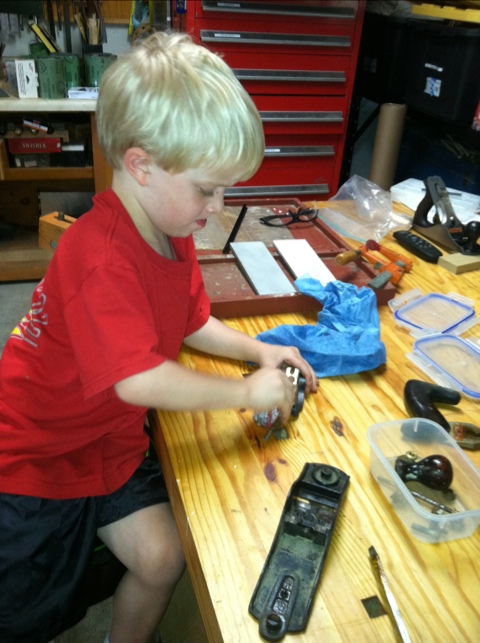
frog conditioning
Waiting for new wilco album to free up my iPhone:)
Explain purpose and function of video
Straight edge to frog
Flatten and smooth frog face
Surface plate and psa sandpaper
Explain blade rigidity and travel in and out.
Improve other machined surfaces at another step.
Plane painting
Paint stripping is now complete on two planes that I have been treating as
prototypes; both are Stanley “Bailey” types- a #65 low angle block plane and a #3 bench plane.
I still have more to
learn and improve on the stripping portion but I will come back to that in another post.
There are a number of options to consider for the paint job. First, I want a finish that can last into the next century for these tools not as museum pieces but as usable and productive tools.
Here are the choices:
1) Brush on enamel
2) Old fashioned happening formula(1:1:1::asphaltum:linseed oil:turpentine) + Baking step. Untested.
3) Pre-mixed “Pontypool” + Baking step. Bought this some time ago and have not used yet.
4) Rustoleum appliance epoxy
5) Rustoleum high heat 500F engine enamel.
6) Rustoleum high heat 2000F semi gloss enamel.
Both planes(the 3 and the 65) were painted with the high heat semi gloss Rustoleum. This was recommended by somebody’s(credit) blog because of the durability and more historically appropriate sheen.
Do we need to bake the Rustoleum finish in the oven? What exactly does baking do for a paint job?
Japanning Stripping
What is japanning?
All of the eBay auctions of handplanes and antique handtools invariably state the percentage of remaning “jappaning” on the tool as part of the item description on the sale listing. Since I am re-building functional tools that should last well into the 21st century, I am more concerned with corrosion protection.
In any case it is an older form of enameling that powder-coat, lacquer, or epoxy has made obsolete.
http://en.wikipedia.org/wiki/Japanning
https://home.comcast.net/~rexmill/planes101/japanning/japanning.htm
I have found a paint/coating stripper that has some promise, RonJohn. It is much less toxic than the methylene chloride that we are used to using, and it doesn’t evaporate as fast.
Materials used:
RonJohn stripper
Acid Brush
#1 “Daily” of plane japanning stripping.
Raw video of japanning stripping of a Stanley # 3 and #65 plane. I am using RonJohn solvent to strip the japanning. Note that I have used a rag soaked with RonJohn to strip the japanning off of the #65. I will let it soak overnight and we will see the results in the morning.
More research is needed on the composition of japanning; it is most likely a coal-tar based substance. It does not peel or bubble off like more modern enamels. It breaks apart into little specks that can be brushed off with a toothbrush.
 Old School Tech